
Savor or Savour: What’s the Difference? (guide 2026)
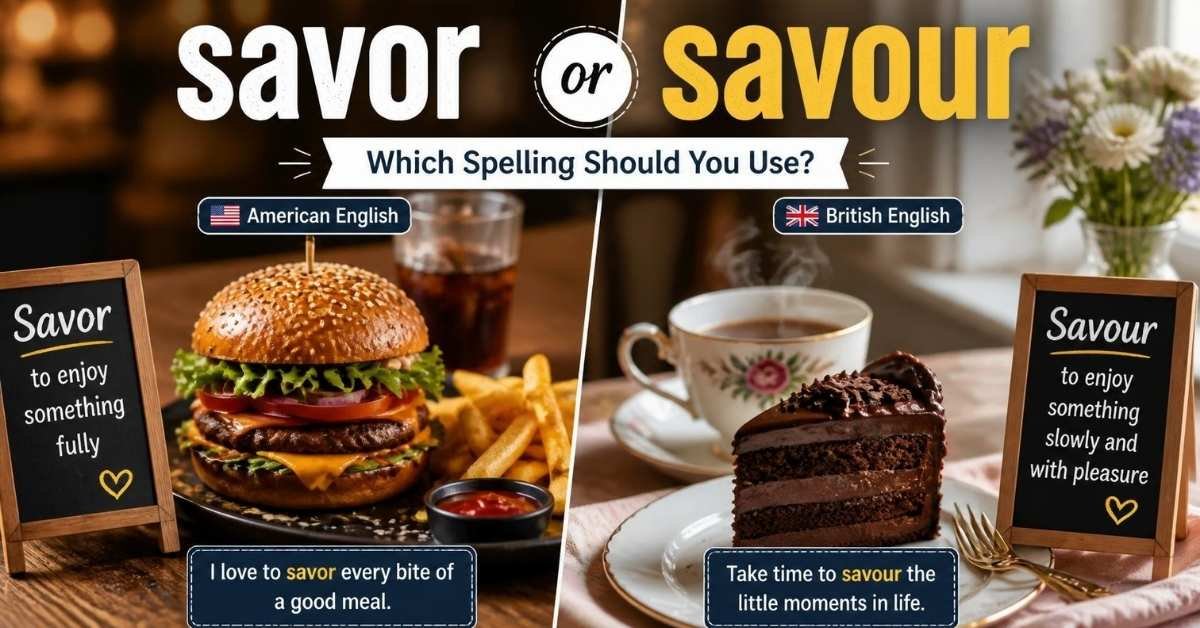
You’re typing a caption about your dinner and you freeze. Is it savor or savour? Did your spell checker just flag a word you’ve used for years?Relax. You didn’t make a mistake. Let’s sort this out quickly.Both spellings are correct. Savor is the American spelling used in the United States. Savour is the British spelling used in the United Kingdom and across Commonwealth countries.
The meaning does not change. Both words describe enjoying fully a taste, a moment, or an experience. Only the spelling changes by region.So the rule is simple. Pick the form that matches your audience, then stay consistent from the first line to the last.
The Origin of Savor or Savour

Both words trace back to the Old French word saveur, which meant taste or flavor. That word came from Latin, and it traveled into English around the 1200s. Back then, spelling was loose, and writers kept the French u in words like this one.
Fast forward to the early 1800s. Noah Webster, the American dictionary maker, wanted a simpler system. He trimmed extra letters, and the dropped letter “u” became a hallmark of American English. Meanwhile, British English held onto the traditional forms.
Here’s the fun part. This wasn’t a fight over meaning. It was a fight over style, and both sides stuck to their choice. That’s language evolution for you, one tiny letter at a time.
British English vs American English Spelling

Think of it like driving. Americans drive on the right, and Brits drive on the left. Both get to the destination, but the road rules differ.
British English spelling keeps the u in words that end in -our. American English spelling drops it. The pattern is steady, so once you learn it, you’ll spot it everywhere. Take a look:
- Color (US) and Colour (UK)
- Flavor (US) and Flavour (UK)
- Honor (US) and Honour (UK)
- Savor (US) and Savour (UK)
These regional spelling patterns explain why a UK recipe site writes “rich flavour” while a US blog writes “rich flavor.” Neither one is wrong. They just belong to different English varieties.
Which Spelling Should You Use?
Your choice depends on who’s reading. Think about where your readers live before you type a single word. A quick check saves you from looking sloppy later.
Here’s a simple way to decide. Match the spelling to your target audience, and don’t overthink it.
Use savor when:
- Your US readers make up most of your audience
- You’re writing for an American company, school, or publication
- Your site or style guide follows American English
- You want the simplified spelling that matches Google Docs set to English (US)
Use savour when:
- Your UK readers or Commonwealth readers are your main crowd
- You’re writing for a British, Australian, or Canadian publication
- Your style guide says British spelling rules apply
- You want the traditional spelling with the u intact
Audience guidance:
Not sure who’s reading? Look at your analytics. Check which countries send you the most traffic, then follow the majority.
For a global audience, pick one form and use one form only. If your brand is American, choose savor. If it’s British, choose savour. Consistency matters more than the letter itself.
Common Mistakes with Savor or Savour
The biggest slip is mixing spellings in one piece. You write “savor” in the intro and “savoured” three paragraphs later. Readers notice, and it makes your writing feel careless.
Another common one is thinking one spelling is wrong. Someone flags “savour” in your draft and tells you to fix it. That’s usually just a wrong regional form for their setup, not an error.
Then there’s the past tense trap. Savored goes with American English, and savoured goes with British English. People often write “savoured” with “color” in the same sentence. Keep every word in the same style.
Here’s a quick checklist to catch these slips:
- Run a spell check set to the right English variant
- Search your draft for “our” endings and match them all
- Read the piece once more just for spelling consistency
- Watch for choosing the wrong spelling because of autocorrect
Savor or Savour in Everyday Examples
Let’s see both words at work. Real sentences stick better than rules. Here’s how they show up in different places.
Emails
You’re writing to a client in Chicago. “I’d like to savor this win with the whole team.” Now picture the same line going to a partner in Manchester. “I’d like to savour this win with the whole team.”
Same friendly tone, different spelling. Match your reader and you look polished.
News
A US paper might run “Fans savored the victory after a tight final.” A UK paper would print “Fans savoured the victory after a tight final.” Editors follow a house style, so you’ll rarely see both in one outlet.
This is a good reminder that success and victory are things people love to savor. It isn’t only about food.
Social Media
Captions are short, so the spelling stands out more. “Sunday coffee, no phone, just savoring every sip.” Or, for a UK feed, “Sunday coffee, no phone, just savouring every sip.”
Pick one and keep it across your profile. Your followers may not say it out loud, but they notice.
Formal Writing
Academic writing and business writing demand steady spelling. A report might say “The team savored the milestone before starting phase two.” A UK version says “savoured.”
Always check the style guide first. Universities and companies often spell it out in detail.
Food Blogs
This is where the word lives. Food blogs and recipes love it. “Slow down and savor every bite of this lemon tart.” UK bloggers write “savour every bite.”
The idea is the same either way. You want your reader to picture a rich flavor and slow down to enjoy the taste.
What Savor and Savour Actually Mean
The meaning and definition covers more than food. To savor something is to experience fully what you’re enjoying. You give it your full attention and let it last.
Yes, you can savor a meal, a dish, or a single bite. You can also savor a quiet morning or a life experience like a graduation. And you can savor success, like a hard-won promotion.
It works as a verb (“I savor my tea”) and as a noun in older writing, where it means a distinct taste or smell. Today the verb use dominates. You’ll see it far more often in phrases like enjoy the moment.
Savor or Savour – Usage Data
Let’s talk about what people search for and why. This is the part that shows real search intent. Understanding it helps you write what readers want.
Why people search this keyword:
- They’re unsure which correct spelling to use
- A spell checker flagged their word
- They’re writing for a different regional audience
- They want to confirm both are right
Popular regions:
Search interest for savor vs savour comes from the United States and the United Kingdom first. India and Pakistan show strong interest too, because both countries lean on British English but see a lot of American content online.
That creates mixed usage in many places. A student in Lahore may read American blogs and British textbooks in the same day. No wonder people get confused.
Usage contexts:
You’ll find the word most in food writing, lifestyle content, and social media captions. It also appears in everyday communication, greeting cards, and motivational posts.
Note that exact search numbers change every month. Check a tool like Google Trends for fresh figures before you quote any numbers.
Comparison Table (Keyword Variations)
Here’s a quick look at both forms side by side. Save it for the next time you doubt yourself.
| Form | Savor | Savour |
| Region | United States | United Kingdom and Commonwealth |
| Style | American English | British English |
| Past tense | Savored | Savoured |
| -ing form | Savoring | Savouring |
| Spelling type | Simplified spelling | Traditional spelling |
| Meaning | Enjoy fully | Enjoy fully |
| Related pair | Color, Flavor, Honor | Colour, Flavour, Honour |
| Best for | US readers | UK readers |
Notice the meaning row. It’s identical. That’s the whole story in one line.
How to Keep Your Spelling Consistent
Consistency is the secret sauce of clear writing. A few small habits make it easy. You don’t need fancy tools to get it right.
First, set your word processor’s language to match your audience. Next, create a tiny style note for your team. Write “US spelling” or “UK spelling” at the top, and everyone follows it.
Finally, do one last pass before you publish. Look at every -our and -or word. If they all match, you’re done. This habit helps professional writing and online content alike.
Other Words That Follow the Same Pattern
Once you know savor or savour, a whole family of words opens up. The dropped u shows up in many everyday terms. Learn the pattern once and you’ll save time for years.
Words like neighbor and neighbour, favor and favour, and labor and labour all work the same way. Be careful though. A few words, like “glamour,” keep the u even in American English. So the pattern is helpful but not a perfect law.
If you’re ever unsure, check a trusted dictionary. It’ll show both forms and tell you which region uses which.
Conclusion
So, savor or savour? Both are right. Use savor for US readers and savour for UK readers. The meaning stays the same, and only the regional spelling changes.Your real job is to match your audience and stay consistent. That’s what makes writing look sharp and trustworthy.
Now over to you. Which spelling do you use, and has a spell checker ever corrected you? Drop a comment, and share this guide with a friend who keeps second guessing their spelling.
FAQs
1. Is “savor” correct?
Yes. It’s the standard form in American English. You’ll see it across US news, books, and websites.
2. Is “savour” correct?
Yes. It’s the standard form in British English and in many Commonwealth countries. It isn’t a typo or a mistake.
3. Do both words mean the same?
Yes. Both mean to enjoy fully a taste, a moment, or an experience. Only the spelling differs.
4. Which spelling is more common?
Overall, it depends on the region. Savor dominates in the US, while savour leads in the UK. Since the US has a huge online audience, “savor” appears often on global sites.
5. Can I use both in one article?
No, avoid it. Using both spellings together looks inconsistent. Pick one and stick with it throughout.
6. Is there a meaning difference?
No. The meaning does not change between the two forms. It’s purely a spelling difference.
7. Which should I use for global readers?
Choose based on your brand and main audience. If most readers are American, go with savor. If most are British or Commonwealth, go with savour. Whichever you pick, keep it steady.
