

Homey or Homie: What’s the Difference ?(2026)
Ever typed a text to a friend and froze over the spelling? Did you mean homey or homie?Here’s the quick answer. Homey describes a cozy, warm place or feeling, while homie means a close friend.
Mix them up and your message sounds a little off. Stick around and you’ll never second guess it again.
Homey or Homie – Quick Answer

Think of it as a simple place vs person rule.
Homey works for a place description or a feeling, and homie works for a person.
A café can feel homey.
Your best buddy from school is your homie.
That’s the whole trick in two lines.
The rest of this guide shows why the split exists and how to use it.
Is it homie or homey
Both spellings are correct, but they do different jobs.
Pick homey for a comfortable atmosphere and homie for a friend.
You’ll sometimes see homey used for a friend too.
That’s an older spelling of the slang term, and it’s a rare variant today.
If you’re unsure, go with homie for people.
It’s the spelling most readers expect in text messages and social media posts.
What Does Homey Mean?
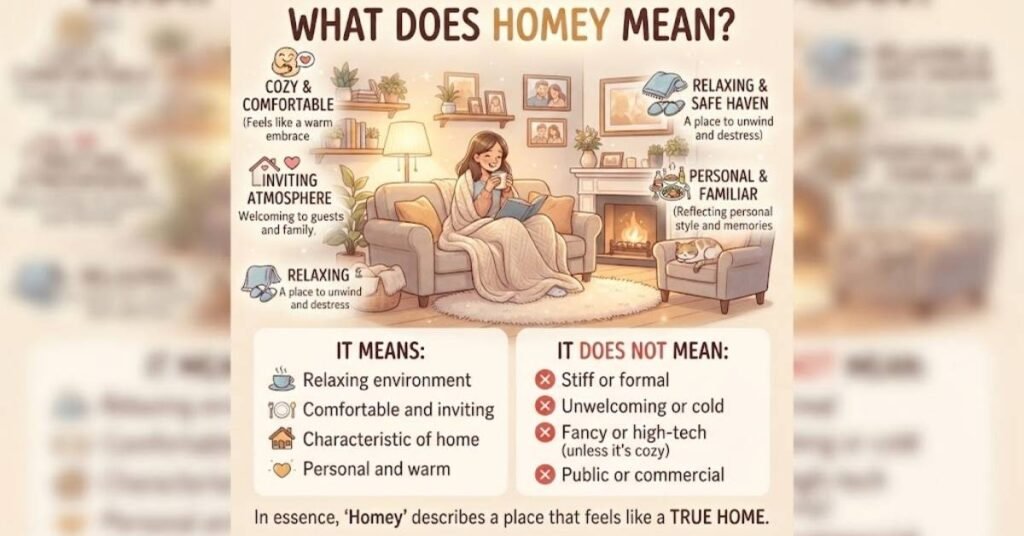
Homey is an adjective.
It describes anything that feels comfortable, welcoming, and relaxing, like a well loved living room.
Picture a small café with mismatched mugs and soft lamps.
You’d say, “This place feels so homey,” and everyone would get it.
Writers use it in lifestyle articles, design articles, and café reviews.
It fits houses, apartments, rooms, restaurants, and even a hotel lobby with a fireplace.
Here are a few things that usually earn the label:
- Warm lighting and soft textures
- A cozy corner with a blanket and a book
- Smells like fresh bread or coffee
- A domestic feeling that says “stay a while”
Notice how every item points to a mood or environment.
That’s your clue that homey is the right word.
What Does Homie Mean?
Homie is a noun.
It means a friend, a buddy, or a companion you trust.
Say your college roommate always has your back.
You’d call him your homie, and he’d probably grin.
A homie is more than a casual acquaintance.
Think trustworthy person, friendship circle, and someone from your same neighborhood or hometown.
You’ll hear it in casual conversation and read it in informal writing.
It also shows up in music, movies, and online posts.
Some people use it for college friends or friends from school.
The tone is warm, relaxed, and positive.
The Origin of Homey or Homie
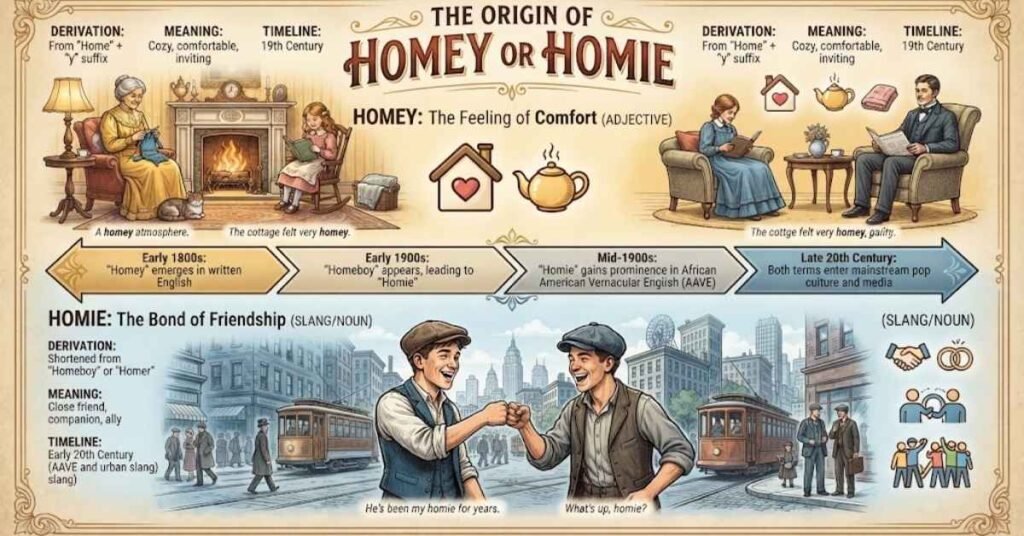
Let’s go back a bit.
The word homeboy grew out of early 20th century American speech, where it meant someone from your hometown.
Over time, American street culture shortened it to homie.
Neighborhood crews, hip hop artists, and film scripts pushed it into everyday talk.
Homey has a separate story.
It’s a much older English word for something homelike, tied to domestic comfort and the idea of home itself.
That overlap explains the confusion.
Both words come from “home,” so the etymology feels shared even though the meanings drifted apart.
Language works like that sometimes.
A single root splits into two branches, and nobody sends a memo. That’s normal word evolution.
You might remember a famous sketch character named Homey D. Clown.
He spelled it the older way, which shows how long the two spellings have bounced around.
British English vs American English Usage
Here’s where geography matters.
Homey works in both British English and American English, though Americans use it more often.
Homie is firmly American slang.
A Londoner is more likely to say “mate” than “homie.”
You’ll still hear homie in the UK.
Music, streaming shows, and internet language carry it across the Atlantic every day.
Then there’s the tricky cousin, homely.
In British usage it often means cozy and pleasant, but Americans tend to hear “plain looking.”
So a British hotel review might praise a “homely” room.
An American reader could miss the compliment, so audience matters when you choose words.
Which One Should You Use?
Start with the person or the place.
If you’re describing a person, homie is your word, and if you’re describing a feeling, pick homey.
Next, check the tone.
Homie belongs in a casual context, while homey can slide into a professional context without trouble.
Here’s a handy rule of thumb:
- Talking about a friend? Use homie.
- Describing a cozy atmosphere? Use homey.
- Writing a formal email, a news article, or academic writing? Skip homie, and use “close friend” instead.
- Writing for a global audience? Keep it plain and skip slang.
Your reader matters more than the rulebook.
Ask yourself who’s reading and what they’d expect.
Common Mistakes with Homey or Homie
The biggest slip is swapping the words.
Writing “Your apartment is so homie” is one of the most common English vocabulary mistakes.
Autocorrect makes it worse.
Your phone may flip homie to homey, or the other way around, and you’ll never notice.
Another mistake is the spelling homy.
It’s a plain typo, so the correct spelling is homey.
People also drop slang into a formal audience setting.
Imagine a work email that says “Thanks, my homie.” That won’t land well with your boss.
Quick fixes you can use today:
- Reread every message that includes either word.
- Check whether you mean a person or a place.
- Turn off aggressive autocorrect for slang.
- Match the word to your audience.
Small habits like these protect your writing clarity.
They take five seconds and save you some awkward moments.
Homey or Homie in Everyday Examples
Real sentences teach faster than rules.
So here are sentence examples that show correct usage in action.
Homey examples:
- “The new bakery feels so homey.”
- “She added plants to make her studio more homey.”
- “That hotel lobby has a homey vibe.”
Homie examples:
- “My homie drove three hours to help me move.”
- “Shoutout to my homies from the old neighborhood.”
- “He’s my homie since school days.”
Now the incorrect usage side.
“Our office is very homie” sounds wrong, and “I’m meeting my homey for lunch” reads like an outdated spelling.
Try writing a few of your own.
Drop them in the comments and we’ll gladly check them for you.
Homey or Homie – Google Trends & Usage Data
Curious how people search these words?
Google Trends is a free tool that shows search trends over time, so you can check the pattern yourself.
Searches for homie usually spike around music releases and viral memes.
Searches for homey tend to follow home décor and interior design seasons, like autumn and the holidays.
This tells us something useful.
People look up the words for different reasons, which proves they’re really different ideas.
Want fresh usage data?
Open Google Trends, type both words, and compare them across your country for the past twelve months.
Comparison Table: Homey vs Homie
Here’s a side by side snapshot.
Save it or screenshot it for later.
| Feature | Homey | Homie |
| Part of speech | Adjective | Noun |
| Meaning | Cozy, warm, comfortable | Close friend, buddy |
| Describes | Places, feelings, moods | People |
| Tone | Neutral to pleasant | Informal slang |
| Best for | Design, reviews, lifestyle writing | Casual chats, social posts |
| Formal writing | Acceptable | Avoid |
| Region | US and UK | Mainly US |
| Example | “A homey kitchen” | “My homie called” |
A table makes the split clear.
If you remember one row, remember “Describes.”
Homey vs Homely: A Quick Bonus
Since we’re on the topic, let’s clear up another similar looking word.
Homely trips up plenty of English learners.
In British English, homely usually means comfortable and unfussy.
In American English, it can suggest someone isn’t attractive.
That’s why homey is the safer pick for a global crowd.
It carries the warm meaning in both places.
Tips to Remember the Difference
Want a memory trick?
Look at the last letters: homie ends in “ie” like “friend,” and homey ends in “ey” like “cozy.”
Another idea is to link homey with home décor.
Then link homie with a hangout crew.
Practice makes it stick.
Spot the word in pop culture, movies, and social media captions, and quiz yourself on which is which.
Conclusion
Now you’ve got the full picture.
Homey is for cozy places and feelings, and homie is for a close friend.
Keep the place vs person rule in your back pocket.
It’ll save you from common mistakes in texts, emails, and posts.
Did this clear things up for you?
Share it with a friend who keeps mixing them up, and tell us your favorite homey spot in the comments.
FAQs
Is homie a real word?
Yes, it’s a real slang term listed in major dictionaries. Check Merriam-Webster, Cambridge Dictionary, or Collins Dictionary for the latest dictionary meaning.
Can I use homie in professional writing?
It’s best to avoid it. Use “close friend” or “colleague” in formal writing and work emails.
Is homey ever slang for a friend?
Sometimes, yes. It’s an older spelling of homie that still appears now and then.
Which spelling is correct for a cozy room?
The correct choice is homey. Homie never describes a place.
Is homy correct?
No, homy is a typo. Stick with homey.
Do British people say homie?
Some do, mostly in casual talk influenced by music and the internet. Most still say “mate” or “friend.”
