
Dudette: Meaning, Origin, Uses, and Modern Alternatives
You’ve heard someone say “hey dudette” and wondered if it’s still a thing people say. Short answer: yes, but with a twist. Dudette is the female counterpart of dude, a casual conversation word that pops up more in nostalgia than in daily texts.This guide breaks down where the word came from, whether it still holds up in 2025, and how to use it without sounding out of touch.
You’ll get real examples, common mistakes, and a straight answer on whether it’s offensive.Think of this as the friend who explains slang without making you feel old. No jargon, no fluff, just the stuff you actually want to know before you drop the word in your next group chat.
What Does Dudette Mean?
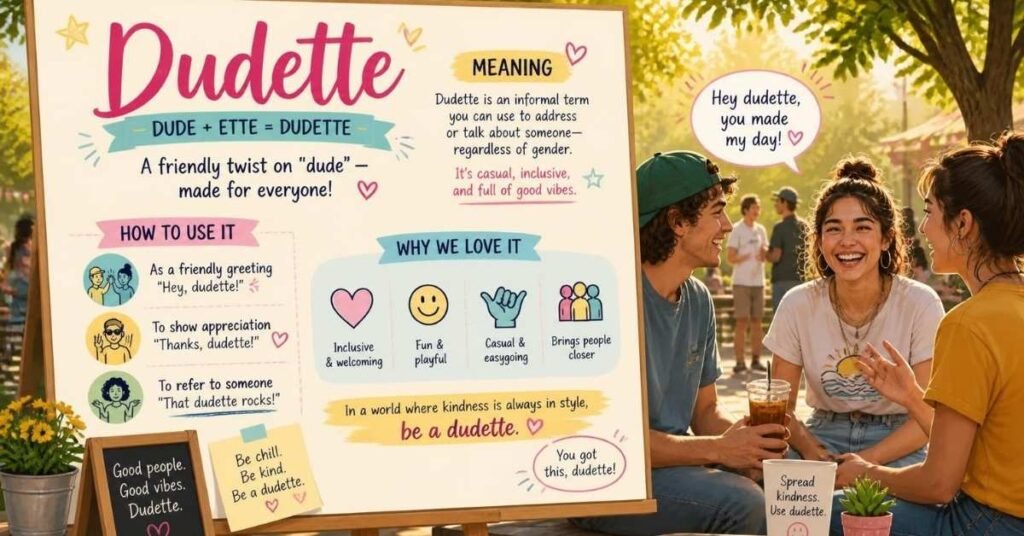
At its core, dudette is an informal slang term used to address or refer to a woman or girl in a relaxed tone. It’s the feminine form of dude, built the same way words like “usher” and “usherette” once were.
People use it as a friendly greeting, a way to call out to a female friend, or just to add a playful expression to a sentence. It carries the same warmth as calling someone “buddy” or “pal,” except it leans more toward humor than sincerity.
The word rarely shows up in professional communication. You’ll hear it among college friends, at a concert, or during a road trip with your crew, not in a business email or job interview.
Simple definition
In plain English, dudette means a girl or woman, spoken with a humorous tone and zero formality. It’s not an insult, and it’s not a compliment either. It’s just a casual way to say “hey you” with some personality attached.
Say it to a bestie and it lands as playful. Say it to a stranger in a formal setting and it lands as odd. Context decides everything here, and that’s true for most slang vocabulary.
Dudette Meaning Table
| Aspect | Details |
| Part of speech | Noun, informal address |
| Meaning | Female version of dude; a woman or girl |
| Tone | Playful, friendly, casual |
| Origin era | Popularized in the late twentieth century |
| Common settings | Texting, social media, casual hangouts |
| Avoid in | Job interviews, academic writing, legal documents |
| Similar words | Girl, sis, bestie, gal |
| Offensive? | Generally no, but tone and audience matter |
Origin of Dudette

The word dude itself has a longer history than most people assume. Some records trace “dude” back to describing a fashionable man or well-dressed man in the nineteenth century, someone who cared a bit too much about looking sharp.
By the time surfing culture and skateboarding culture picked it up in the mid to late 1900s, dude had shifted meaning entirely. Surfers and skateboarders used it as a laid-back way to address anyone, man or otherwise, and that’s roughly when dudette entered the picture as its natural counterpart.
The 1980s and 1990s cemented dudette in pop culture. Teen movies and television shows from that stretch leaned hard on both words, and an entire generation of young adults grew up saying them without a second thought.
Is Dudette Still Used Today?
Here’s the honest truth. Dudette hasn’t vanished, but it’s not exactly thriving either. It sits somewhere between retro term and occasional throwback, something you’d use half-jokingly rather than as your go-to word for addressing a friend.
Younger English speakers tend to reach for words like “sis,” “bestie,” or just first names instead. That said, dudette still shows up in nostalgic discussions, retro-themed discussions, and plenty of online gaming chats where players lean into an exaggerated, throwback tone on purpose.
So no, it’s not dead. It’s more like that one song from your childhood that still gets played at parties, just less often than it used to.
When to Use Dudette
Timing matters more than the word itself. Use it when the mood is light, the audience is familiar, and nobody’s going to raise an eyebrow at a bit of friendly slang.
Good examples
- Greeting a close friend at a sports game
- Reacting to good news over text message
- Joking around during a movie night or pizza run
- Wishing someone a fun birthday greeting
- Hyping up a companion before a big event
Situations to avoid
- Job interviews or client calls
- Academic writing or research papers
- Legal documents or official correspondence
- Talking to a new colleague you haven’t built rapport with
- Addressing someone who hasn’t shared their preferred way to be called
Dudette in Texting and Social Media
Texting slang and internet slang move fast, and dudette has found a small but steady home there. You’ll spot it in social media captions, casual online chats, and comment sections where people are clearly not taking themselves too seriously.
It works well in social media posts aiming for a nostalgic or humorous vibe. Brands chasing a retro aesthetic sometimes drop it intentionally, almost like a wink to older internet culture.
On the flip side, it rarely appears in more polished or professional social communication. LinkedIn posts, for instance, almost never use it, because the platform’s whole vibe leans formal even when the content is casual.
Examples of Dudette in Everyday Conversation
Picture this. You’re walking into chemistry class late, and your lab partner grins and says, “Nice of you to join us, dudette.” Nobody’s offended. Everyone laughs. That’s the word doing exactly what it’s built for.
Or maybe you’re on a road trip, radio blasting, and someone shouts “Dudette, you HAVE to hear this song.” It’s not a big statement. It’s just enthusiasm wrapped in casual English.
Here are a few more everyday lines where it fits naturally:
- “Dudette, that concert was insane last night.”
- “Chill out, dudette, we’ve got plenty of time.”
- “Dudette, pass the pizza before it’s all gone.”
- “You crushed that presentation, dudette.”
Dudette Versus Dude
Dude is the original, and it’s aged into something close to gender-neutral language for a lot of speakers. Plenty of people now say “dude” regardless of who they’re talking to, which raises a fair question: is dude gender neutral now, and does that make dudette obsolete?
Not quite. Dude has broadened, sure, but dudette still exists as the intentional gender-specific slang choice when someone wants to specifically highlight or address a woman in a playful way. It’s less about necessity and more about flavor.
Think of dude as the everyday default and dudette as the specialty version you pull out for extra emphasis or humor. Neither one is right or wrong. It really comes down to speaker preference and the tone they’re going for.
Similar Words and Related Phrases
Modern English has no shortage of alternatives if dudette doesn’t fit your style. Some carry the same energy, others swap playfulness for warmth.
- Sis – close, warm, and widely used across age groups
- Bestie – best friend energy, often used online
- Gal – slightly retro but still common in casual speech
- Girl – simple and universally understood
- Buddy – gender-neutral, friendly, and safe in most settings
- Pal – old-school but still functional today
These related phrases all serve a similar purpose: keeping conversation light and building connection through friendly communication.
Common Use Cases
Dudette earns its keep in a handful of predictable spots. It’s a natural fit for greeting female friends, especially in group settings where everyone’s already comfortable joking around.
It also shows up in humorous storytelling, the kind where you’re recapping a wild weekend to friends and want the retelling to feel animated. Gamers use it too, particularly in voice chats where an exaggerated, throwback tone adds personality to trash talk or celebration.
Beyond that, expect it in nostalgic slang conversations, think group chats reminiscing about 90s movies, where using the actual outdated expression makes the whole exchange funnier.
Common Mistakes
Even a simple word like this trips people up. Here’s where things usually go sideways.
Assuming everyone uses it
Not every audience vibes with dudette. Some people find it dated, others just never picked it up regionally. Read the room before assuming it’ll land the way you want.
Using it in formal situations
Workplace communication, schools, and any setting requiring respect deserve more neutral language. Save dudette for downtime, not deadlines.
Thinking it is offensive
Most of the time, it’s not an insult at all. It’s a neutral term rooted in humor, not disrespect, though tone can shift that slightly depending on delivery.
Confusing it with modern preferences
Language evolves, and some people prefer being addressed by their person’s name rather than any slang term, feminine or otherwise. Always respect preferences over defaulting to a catchphrase.
Is Dudette Offensive?
Generally, no. Dudette carries a friendly tone, not a hostile one, and most people who hear it understand the intent behind it immediately. It’s built for humor, not harm.
That said, context still rules. Using it sarcastically, repeatedly after someone’s asked you to stop, or toward someone you barely know can tip it into annoying territory, even if it was never meant as an offensive language choice.
The safest approach? Save it for people you already joke around with. That’s where it always sounds right.
Additional Word Trends Worth Knowing
Slang doesn’t sit still, and dudette’s story connects to a bigger shift in how people address each other. Gender-neutral language has been gaining ground across everyday speech, with terms like “folks,” “team,” and even “dude” itself stretching to cover everyone.
At the same time, there’s a countertrend of people leaning into feminine form words on purpose, almost as a stylistic choice rather than a necessity. Dudette fits neatly into that second category, chosen for flavor rather than grammatical requirement.
Watching how these two trends pull against each other tells you a lot about where casual English is headed. Expect more blending, fewer hard rules, and continued room for words like dudette to survive as flavor text in modern slang.
How Audience and Context Shape Slang Choices
Every word in your slang vocabulary carries weight depending on who’s listening. A joke that lands with your companion on a road trip might completely miss with a new colleague at lunch.
That’s why communication style matters as much as the word itself. Dudette works when the relationship already has warmth built in. Without that foundation, even the friendliest term can land flat or, worse, feel forced.
Paying attention to your speaker intent, and reading the other person’s comfort level, saves you from most slang-related misfires, dudette included.
Conclusion
Dudette isn’t dead, and it isn’t exactly thriving either. It’s a playful expression with real history, born out of surfing culture and cemented by decades of pop culture exposure, and it still has a place in casual, friendly interaction today.
Use it with people who’ll appreciate the humor. Skip it in formal settings. And if someone ever tells you they’d rather you didn’t use it, swap it out without making a fuss. That’s just good communication, dudette or not.
FAQs
What does dudette mean?
Dudette means a woman or girl, used as a casual greeting or friendly address in relaxed, informal settings.
Is dudette still popular?
It’s less common than it was in the 90s, but it still appears in nostalgic discussions, gaming chats, and casual banter.
Is dudette rude?
Not typically. It’s a neutral term with a playful edge, though tone and familiarity with the listener still matter.
Can I call my friend dudette?
Yes, especially if your friendship already includes joking around and informal English. Just read their reaction the first time you use it.
Is dude gender neutral now?
For many speakers, yes. Dude has broadened over time, though dudette still exists for people who want a specifically feminine, playful option.
Where did dudette come from?
It grew out of surfing culture and skateboarding culture, following dude’s own shift from describing a well-dressed man to a casual term of address.
Is dudette used in texting?
Yes, it shows up in text messages and online chats, usually when the tone is light, joking, or nostalgic.