
DDLG Meaning: Understand Roles, Rules & Real Relationship Examples
What does DDLG actually mean when people use it in relationship conversations?Does DDLG automatically mean BDSM, age play, or something sexual?Not necessarily.DDLG commonly refers to Daddy Dom Little Girl, a relationship dynamic built around agreed roles, care, guidance, trust, and emotional connection between consenting adults.
The names can sound confusing at first, especially if you’ve only seen DDLG slang on socialmedia or online forums.In practice, every DDLG relationship can look different because partners decide their own boundaries, expectations, routines, and level of structure.
What Does DDLG Mean in Slang and Relationships

In casual conversations, DDLG is shorthand for a particular relationship style involving a Daddy Dom and a Little.
The terms describe agreed relationship roles rather than automatically describing someone’s actual age.
A typical DDLG dynamic may involve emotional support, nurturing, reassurance, guidance, routines, and a stronger sense of relationship structure.
Some couples keep those roles private, while others use them openly between partners.
The important point is that mutual agreement, consent, and personal comfort shape the relationship.
DDLG Full Form and Definition Explained
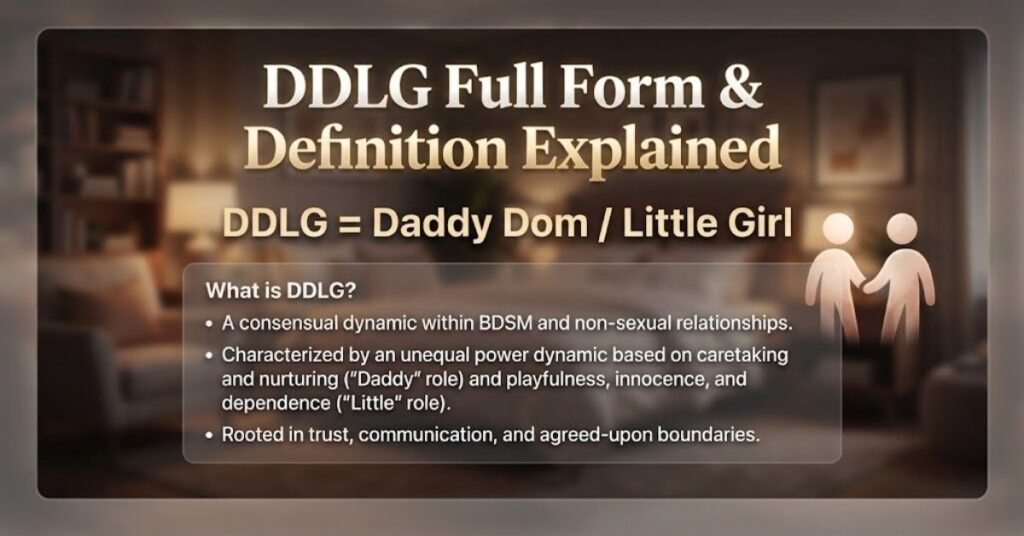
DDLG stands for Daddy Dom Little Girl.
“Daddy” generally describes the guiding role, while “Little” commonly describes the softer role within the agreed dynamic.
Those labels don’t create automatic authority.
Instead, partners establish what the roles mean through open communication, clear boundaries, and agreed expectations.
For one couple, the dynamic might focus mostly on reassurance and nurturing.
For another, it may include routines, decision guidance, or structured responsibilities.
DDLG Dynamics in Relationships (Daddy Dom Little Girl Meaning)

The Daddy Dom Little Girl dynamic usually centers on a negotiated difference in relationship roles.
The Daddy Dom may take a more protective role, while the Little may seek more comfort, reassurance, guidance, or emotional closeness.
That doesn’t mean one partner becomes the boss of the other in every part of life.
Healthy power dynamics remain negotiated, and both adults retain their ability to say no, change an agreement, or leave the arrangement.
Is DDLG a Kink or Lifestyle
People describe DDLG in different ways.
Some consider it a kink or part of kink culture, while others treat it as a broader relationship style that influences everyday routines and emotional interaction.
There isn’t one universal definition that fits every couple.
A person might use DDLG only during certain private interactions.
Another couple may incorporate caregiver behavior, routines, emotional reassurance, and defined roles into their daily relationship.
DDLG Rules and Relationship Structure
DDLG rules should never appear out of nowhere.
Partners need to discuss what the relationship structure means, which behaviors feel comfortable, and where each person’s personal boundaries sit.
Good agreements create clarity, not fear.
They can cover communication habits, routines, privacy, disagreements, personal space, and situations where either partner wants to pause the dynamic.
Common DDLG Roles Explained
The two commonly discussed roles are Daddy Dom and Little.
However, the exact emotional roles depend on the people involved.
The Daddy Dom role may include guidance, listening, consistency, reassurance, and a sense of responsibility.
The Little role may involve comfort seeking, emotional openness, vulnerability, or enjoying a softer relationship position.
Neither role should erase the other person’s independence.
Responsibilities of a Daddy Dom
A responsible Daddy Dom focuses on care, communication, consistency, and agreed boundaries.
Leadership doesn’t mean ignoring the other person’s wishes.
Useful responsibilities can include:
- Listening before making decisions.
- Respecting stated limits.
- Providing agreed emotional support.
- Maintaining mutually agreed routines.
- Handling disagreements calmly.
- Checking whether the dynamic still feels comfortable.
Responsibilities of a Little
A Little also has responsibilities within the DDLG relationship.
The softer role doesn’t remove the need for honesty, communication, or personal responsibility.
A Little should communicate needs clearly, respect agreed rules, maintain personal boundaries, and speak up when something feels uncomfortable.
That balance helps create mutual trust instead of dependence without limits.
Types of DDLG Relationships
There isn’t one fixed DDLG relationship model.
Some couples prefer a relaxed arrangement with flexible roles, while others enjoy more defined routines and expectations.
The best description is the one that accurately reflects the partners’ own agreement.
Soft DDLG vs Strict DDLG
Soft DDLG usually involves lighter structure and greater flexibility.
The focus may sit around nurturing, emotional reassurance, affection, comfort, and occasional guidance.
A more structured arrangement may involve clearer routines, defined expectations, and agreed rules.
Even then, strictness shouldn’t replace consent, respect, or communication.
Online vs Real-Life DDLG Relationships
An online DDLG dynamic may develop through messaging, calls, communities, or other forms of daily interaction.
Partners can establish routines and emotional closeness without sharing the same physical space.
A real-life DDLG relationship can include everyday activities such as shared routines, check-ins, planning, and supportive behavior.
Online relationships still need privacy boundaries and realistic expectations.
Common DDLG Terms and Slang
Understanding common DDLG terms makes online discussions easier to follow.
Still, slang can vary between communities, so don’t assume every person uses a word in exactly the same way.
Caregiver and Little Space Meaning
Caregiver generally describes someone who takes on a nurturing or supportive role.
The caregiver role can overlap with the Daddy Dom role, although the terms aren’t necessarily identical.
Little space commonly describes a mental or emotional state where a person adopts a younger, softer, playful, or comfort-focused mindset.
It’s a personal experience rather than proof that someone has literally become a child.
Brat, Punishment and Rewards Explained
A brat may describe someone who intentionally acts playfully challenging within an agreed relationship dynamic.
Terms such as punishment and rewards can also appear in DDLG communities.
Healthy couples should define exactly what those words mean before using them.
Any consequence should remain within previously agreed limits and should never become coercion, humiliation, intimidation, or unwanted control.
DDLG vs BDSM: Key Differences
DDLG and BDSM can overlap, but they’re not interchangeable terms.
BDSM is a broad umbrella involving concepts such as bondage, dominance, submission, sadism, and masochism.
DDLG focuses more specifically on a relationship dynamic involving caregiver-style roles and a particular form of power exchange.
Emotional vs Physical Dominance
Emotional dominance can involve guidance, reassurance, leadership, or structured interaction.
Physical dominance focuses more on physical power or physical activities.
DDLG doesn’t automatically require physical elements.
A couple can have a strongly emotional DDLG dynamic without incorporating physical dominance.
Power Dynamics Comparison
Both DDLG and BDSM dynamics can involve negotiated power exchange.
The difference comes from the specific relationship framework and activities involved.
Someone can practice BDSM without identifying with DDLG.
Likewise, someone can describe a DDLG relationship primarily through care, nurturing, and emotional connection.
DDLG vs Age Play: Are They the Same
DDLG and age play aren’t automatically the same thing.
Age play usually involves age-based roleplay, such as intentionally adopting younger behavior or a particular age-related character.
DDLG may include that element for some adults, but it doesn’t have to.
Key Differences Between DDLG and Age Play
The central difference is the focus.
Age play centers on roleplaying an age or age-associated behavior.
DDLG centers more on a particular relationship structure involving a Daddy Dom, Little, caregiving, guidance, and negotiated roles.
Some relationships may include both, while others use only one.
Misconceptions About DDLG
One common misconception is that DDLG means someone is pretending to be an actual child.
That’s not an accurate description of the adult relationship itself.
Another misconception is that every DDLG relationship involves the same rules, activities, or level of structure.
In reality, personal preference, consent, communication, and comfort zones vary considerably.
DDLG vs Traditional Relationships
A DDLG relationship can still contain many features found in other adult relationships.
Partners can share finances, hobbies, friendships, household responsibilities, emotional support, and long-term plans.
The noticeable difference is often the intentional use of defined relationship roles.
Emotional Needs Comparison
Most relationships involve trust, reassurance, communication, respect, and emotional closeness.
DDLG may place stronger emphasis on nurturing, comfort, guidance, and structured emotional support.
That doesn’t make ordinary relationships emotionally weaker.
It simply means partners organize their emotional needs differently.
Structure and Boundaries Difference
Traditional relationships often use flexible roles that change depending on circumstances.
A DDLG relationship may use more clearly defined roles, routines, or expectations.
Neither approach automatically guarantees a healthy relationship.
The real issue is whether both people feel respected, heard, safe, and free to communicate.
DDLG Comparison Table
| Relationship type | Main focus | Roles | Structure |
| DDLG | Care, guidance, defined roles | Daddy Dom and Little | Flexible to structured |
| BDSM | Power exchange and negotiated activities | Varies | Varies widely |
| Age play | Age-based roleplay | Varies | Usually role-specific |
| Traditional relationship | Mutual partnership | Usually flexible | Usually flexible |
These categories can overlap.
A relationship might include DDLG, BDSM elements, or age play while still maintaining ordinary partnership responsibilities.
Common Idioms Related to DDLG Dynamics
Everyday relationship conversations often use idioms that describe boundaries, leadership, and cooperation.
They don’t have special DDLG meanings, but they can help explain relationship situations.
Rule of Thumb
A rule of thumb means a practical general guideline.
For example, couples might use a simple rule of thumb when discussing communication or daily routines.
Draw the Line
To draw the line means to establish a clear boundary.
That matters when partners discuss acceptable limits.
Take Control
To take control means assuming responsibility for a situation.
In DDLG, that should always remain within agreed expectations.
Walk on Eggshells
Walk on eggshells describes feeling nervous about upsetting someone.
A healthy relationship shouldn’t require constant fear of saying the wrong thing.
In Safe Hands
Being in safe hands suggests feeling protected and cared for.
That feeling depends on reliability, respect, and consistent behavior.
Call the Shots
To call the shots means making decisions.
In a healthy DDLG arrangement, decision-making should stay within the boundaries both partners agreed upon.
Play by the Rules
To play by the rules means following agreed guidelines.
Clear rules work better when both people understand why they exist.
Cross the Line
To cross the line means violating a boundary.
Partners should be able to identify those boundaries before problems arise.
Know Your Limits
Know your limits means understanding what you can comfortably accept.
This applies to emotional and practical boundaries.
Push the Boundaries
Push the boundaries can mean testing limits.
In a relationship, that should never become an excuse for ignoring consent.
Keep in Check
To keep in check means keeping something under control.
Healthy relationship structure can help partners keep routines and expectations in check.
On the Same Page
Being on the same page means sharing the same understanding.
This is essential when discussing roles and rules.
Set the Tone
To set the tone means establishing the mood or approach.
Respectful communication can set a calmer tone for difficult conversations.
Follow Through
To follow through means doing what you agreed to do.
Consistency matters when partners depend on agreed routines.
Stay in Line
Stay in line can mean following an established expectation.
It shouldn’t be used to justify controlling another adult.
Break the Rules
To break the rules means ignoring an agreement.
If a rule no longer works, discussing it is healthier than silently changing it.
Hold Your Ground
To hold your ground means standing by an important boundary.
This can help protect personal comfort and emotional safety.
Give and Take
Give and take describes mutual compromise.
Even relationships with defined roles need flexibility.
Step Up
To step up means accepting responsibility when needed.
A supportive partner steps up without using responsibility as an excuse for control.
Fall in Line
To fall in line means conforming to an expectation.
In adult relationships, this idea should never replace mutual agreement.
Practical Usage of DDLG in Real Life
What might a DDLG dynamic actually look like outside internet discussions?
It could be surprisingly ordinary.
A couple might use agreed pet names, morning check-ins, shared routines, reassurance during stressful days, or specific ways of handling decisions.
Examples
Imagine two consenting adults who agree that one partner takes the guiding role during certain situations.
They might create a simple evening routine where they check in, discuss tomorrow’s plans, and talk about anything that caused stress.
Another couple might use gentle rules around sleep, communication, or personal goals.
The details matter less than whether both partners understand the arrangement and genuinely want it.
How to Use DDLG in a Relationship
Start with a conversation rather than jumping straight into rules.
Discuss what each person wants from the relationship dynamic, what feels uncomfortable, and which parts should remain private.
Write down important agreements if that makes communication easier.
Useful topics include:
- Boundaries and limits
- Communication during disagreements
- Privacy and social situations
- Daily routines
- Responsibilities
- Words or roles that feel comfortable
- How either person can pause the dynamic
Keep checking in.
People change, and an agreement that felt right six months ago may need adjustment.
Common Mistakes in DDLG Relationships
The biggest problems usually appear when partners confuse care with control.
A guiding role doesn’t give someone unlimited authority over another adult’s friendships, money, work, body, communication, or personal decisions.
Watch for these common mistakes:
- Ignoring consent
- Assuming roles without discussion
- Using pressure instead of communication
- Treating rules as permanent
- Ignoring emotional boundaries
- Confusing dependence with healthy support
- Refusing to discuss discomfort
- Using punishment to intimidate
- Creating unrealistic expectations
- Allowing stigma to replace honest conversation
Healthy structure should make communication easier, not make one partner afraid to speak.
Is DDLG Safe and Healthy
DDLG can be part of a healthy adult relationship when partners freely choose the dynamic and maintain clear boundaries.
Safety depends less on the label and more on behavior.
Look for mutual respect, informed consent, emotional safety, honesty, reliable communication, and the ability to stop or change the dynamic.
A healthy arrangement also leaves room for ordinary adult independence.
If someone uses the DDLG label to justify threats, isolation, financial control, coercion, or unwanted behavior, the label doesn’t make those actions healthy.
A Simple Way to Set Healthy DDLG Boundaries
Before establishing a DDLG relationship, talk through the practical details.
You can ask:
- What does the Daddy Dom role mean to you?
- What does the Little role mean to you?
- Which rules feel supportive rather than restrictive?
- What are your non-negotiable boundaries?
- How will either person say “stop”?
- How will disagreements be handled?
- Which parts stay private?
- When should you review the agreement?
These questions turn vague expectations into clear agreements.
They also give both partners a chance to speak openly before misunderstandings grow.
Conclusion
So, what is the DDLG meaning in relationships?DDLG means Daddy Dom Little Girl, a consensual adult relationship dynamic involving defined roles that may include caregiving, guidance, nurturing, structure, and emotional support.It isn’t automatically the same as BDSM or age play, although some people may combine these dynamics.
The most important pieces are consent, trust, communication, personal boundaries, mutual respect, and emotional safety.If you’re exploring DDLG yourself, don’t worry about copying someone else’s rulebook.Start with an honest conversation, decide what feels comfortable, and keep checking that both partners still feel respected.
FAQs
What does DDLG mean in a relationship
It describes a consensual adult relationship dynamic where partners take defined roles that may involve guidance, caregiving, nurturing, reassurance, routines, or structured support.
Is DDLG the same as BDSM
No.BDSM is a broad category covering various forms of negotiated power exchange and related practices.
Is DDLG safe for beginners
It can be approached safely when adults discuss consent, boundaries, expectations, privacy, and communication before adopting the dynamic.
What are DDLG rules
DDLG rules are mutually agreed guidelines that define how the relationship dynamic works.They might cover routines, communication, responsibilities, privacy, boundaries, or specific expectations.
Can DDLG be non sexual
Yes.Some adults describe their DDLG dynamic mainly through emotional care, nurturing, reassurance, guidance, routines, and relationship roles.